Many people come to counselling because they're worried about their grief. They might say things like, "I should be coping better by now" or "I thought this would hurt less as time went on". Often. they've been told - directly or indirectly - that grief follows neat stages, or that healing means "letting go" and moving on.
The Tonkin model of grief offers a very different , and often deeply relieving, way of understanding loss.
What is the Tonkin Model of Grief?
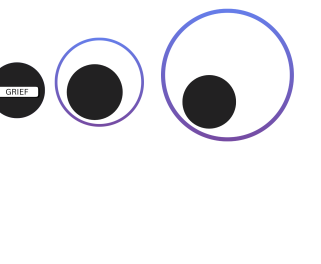
Developed by grief researcher Lois Tonkin, the Tonkin model (sometimes called "Growing Around Grief") challenges the idea that grief gets smaller over time. Instead, it suggests that grief stays the same size - but our lives can grow around it.
In the early days after a significant loss, grief can feel all-consuming. It fills your thoughts, your body, and your daily life. There may be very little space for anything else. In the Tonkin model, grief is represented as a large circle, with only a small amount of "life" around it.
Over time, however, something important can happen. The grief doesn't disappear, and it doesn't shrink. But slowly, life begins to expand around it. New experiences, relationships, routines and moments of meaning start to take up space alongside the grief. Eventually, while grief remains present, it no longer dominates every moment in the same way.
For many people, this model feels more honest than the idea of "getting over" a loss.
Why This Model Resonates With So Many People
One of the most common reactions clients have when they first encounter the Tonkin model is relief. It gives permission to keep loving, missing and grieving without feeling they are failing at healing.
Grief often reflects love, attachment and meaning. Expecting it to vanish can feel unrealistic - or even disrespectful to the relationship that was lost. The Tonkin model normalises the idea that grief may always be part of you, while also holding hope that life can still grow, deepen and contain joy again.
This can be especially helpful for people who feel stuck because their grief hasn't followed a predictable timeline.
The Second Year of Grief: Why It Can Feel Harder
Many clients I work with share a similar experience: the second year of grief can feel harder than the first. This often comes as a surprise and can bring a lot of self judgement.
In the first year, there is often shock, survival mode, and external support. Friends and family may check in more regularly. There are "firsts" to get through - first birthdays, anniversaries and holidays - which, while painful, are often acknowledged by others.
By the second year, the world tends to move on. Support may fade, expectations increase, and there and there can be an unspoken assumption that you should be "back to normal". At the same time, the reality of the loss can feel more permanent . The finality settles in.
Within the Tonkin model, this makes sense. Life is starting to expand again, but the grief is still very much there. This can create internal conflict: "If my life is growing, why does this still hurt so much?" . The model reassures us that both can exist together.
Understanding this can help reduce the shame and isolation during a period that many people struggle through quietly.
How the Tonkin Model is Used in Counselling
In counselling, the Tonkin model can be a powerful visual and emotional tool. It helps clients externalise their grief rather than seeing it as a personal weakness or something they are doing wrong.
We might explore questions such as:
- What does your grief circle look like right now?
- Where do you notice life trying to grow around it?
- What feels blocked or unsupported?
- What would it look like to allow grief to stay, rather than fighting it?
Importantly, this model doesn't rush the process. It respects that growth happens at different paces for different people, and that setbacks, anniversaries, and new losses can temporarily make grief feel larger again.
You Don't Have to Carry Grief Alone
While grief is a universal experience, it can also be profoundly lonely. If you recognise yourself in this description - especially if you're in that second year - it may hep to talk with someone who understands how grief works.
Counselling isn't about "fixing" grief or making it disappear. It's about creating space for your experience, supporting life to grow around the loss, and helping you feel less alone as you navigate it.
If you'd like to explore the Tonkin model in a supportive, compassionate setting, I'd be honoured to walk alongside you.
I currently have counselling available on Wednesdays and Fridays, and I offer a calm and safe space to explore your grief at your own pace. I offer new clients a free initial phone call to allow for a gentle conversation and allows you to decide in your own time, whether you'd like to book in.